Церковные ВѢХИ

Extra Ecclesiam nulla salus. Outside the Church there is no salvation, because salvation is the Church. For salvation is the revelation of the way for everyone who believes in Christ's name. This revelation is to be found only in the Church. In the Church, as in the Body of Christ, in its theanthropic organism, the mystery of incarnation, the mystery of the "two natures," indissolubly united, is continually accomplished. -Fr. Georges Florovsky

ΟΡΘΟΔΟΞΙΑ Ή ΘΑΝΑΤΟΣ!

ΟΡΘΟΔΟΞΙΑ Ή ΘΑΝΑΤΟΣ!
§ 20. For our faith, brethren, is not of men nor by man, but by revelation of Jesus Christ, which the divine Apostles preached, the holy Ecumenical Councils confirmed, the greatest and wisest teachers of the world handed down in succession, and the shed blood of the holy martyrs ratified. Let us hold fast to the confession which we have received unadulterated from such men, turning away from every novelty as a suggestion of the devil. He that accepts a novelty reproaches with deficiency the preached Orthodox Faith. But that Faith has long ago been sealed in completeness, not to admit of diminution or increase, or any change whatever; and he who dares to do, or advise, or think of such a thing has already denied the faith of Christ, has already of his own accord been struck with an eternal anathema, for blaspheming the Holy Ghost as not having spoken fully in the Scriptures and through the Ecumenical Councils. This fearful anathema, brethren and sons beloved in Christ, we do not pronounce today, but our Savior first pronounced it (Matt. xii. 32): Whosoever speaketh against the Holy Ghost, it shall not be forgiven him, neither in this world, neither in the world to come. St. Paul pronounced the same anathema (Gal. i. 6): I marvel that ye are so soon removed from Him that called you into the grace of Christ, unto another Gospel: which is not another; but there be some that trouble you, and would pervert the Gospel of Christ. But though we, or an angel from heaven, preach any other gospel unto you, than that which we have preached unto you, let him be accursed. This same anathema the Seven Ecumenical Councils and the whole choir of God-serving fathers pronounced. All, therefore, innovating, either by heresy or schism, have voluntarily clothed themselves, according to the Psalm (cix. 18), ("with a curse as with a garment,") whether they be Popes, or Patriarchs, or Clergy, or Laity; nay, if any one, though an angel from heaven, preach any other Gospel unto you than that ye have received, let him be accursed. Thus our wise fathers, obedient to the soul-saving words of St. Paul, were established firm and steadfast in the faith handed down unbrokenly to them, and preserved it unchanged and uncontaminate in the midst of so many heresies, and have delivered it to us pure and undefiled, as it came pure from the mouth of the first servants of the Word. Let us, too, thus wise, transmit it, pure as we have received it, to coming generations, altering nothing, that they may be, as we are, full of confidence, and with nothing to be ashamed of when speaking of the faith of their forefathers. - Encyclical of the Holy Eastern Patriarchs of 1848

За ВѢру Царя И Отечество

За ВѢру Царя И Отечество
«Кто еси мимо грядый о нас невѣдущиiй, Елицы здѣ естесмо положены сущи, Понеже нам страсть и смерть повѣлѣ молчати, Сей камень возопiетъ о насъ ти вѣщати, И за правду и вѣрность къ Монарсѣ нашу Страданiя и смерти испiймо чашу, Злуданьем Мазепы, всевѣчно правы, Посѣченны зоставше топоромъ во главы; Почиваемъ въ семъ мѣстѣ Матери Владычнѣ, Подающiя всѣмъ своимъ рабомъ животь вѣчный. Року 1708, мѣсяца iюля 15 дня, посѣчены средь Обозу войсковаго, за Бѣлою Церковiю на Борщаговцѣ и Ковшевомъ, благородный Василiй Кочубей, судiя генеральный; Iоаннъ Искра, полковникъ полтавскiй. Привезены же тѣла ихъ iюля 17 въ Кiевъ и того жъ дня въ обители святой Печерской на семъ мѣстѣ погребены».
Showing posts with label Russian Folk Tales. Show all posts

Thursday, June 24, 2010

The Magic Ring

In a certain realm, in a certain land, there once lived an old man and woman with their only son Martin. All his life the old man had been a hunter, catching animals and birds and feeding his family on his catch. With time the old man took sick and died, leaving Martin and his mother alone in the world; they grieved and sorrowed, but there was nothing for it: tears won't bring back the dead. A week passed by and they had eaten all the food in the larder; seeing there was nothing more to eat, the old woman realised she would have to spend some money. The old man had left them two hundred rubles; though she was loath to open the money- box, they had to eat somehow and keep the wolf from the door. So she counted off a hundred rubles and told her son, "Here, Martin, take these hundred notes and borrow the neighbour's horse so that you can ride to town and buy some food. That will see us through the winter and we will look for work come the spring."

Martin borrowed his neighbour's horse and cart and rode off to town; as he was passing butchers' stalls in the market he saw a noisy crowd gathered there. What had happened? The butchers had caught a hound, tied him to a post and were beating him with sticks, and the dog was cowering, whining and yapping with pain. Martin ran over to the butchers and asked, "Why are you beating the poor dog so mercilessly?" "That devil deserves all he gets," the butchers said. "He stole a whole side of beef." "Stop, brothers," Martin cried. "Don't beat him, sell him to me instead." "Buy him if you please, but it will cost you a hundred rubles." said one butcher in jest. Martin pulled out a hundred rubles, paid the butcher, untied the hound and took him along. The dog wagged his tail and licked his new master's hand; he knew the young fellow had saved his life.

When Martin got back home, his mother asked him at once, "What have you bought, my boy?" "My first piece of good fortune," Martin replied. "What are you blathering about? What good fortune?" "Here it is, Blackie," he said pointing at the dog. "Is that all?" "If I'd had any money left I might have bought more: but the whole hundred went on the dog." The old woman scolded him: "We've nothing to eat; I've scraped the last bits of flour to make a roll for today, but tomorrow there'll be nothing at all."

Next day his mother took out the last hundred rubles, gave it to her son and told him: "Go to town and buy some food. son. but don't fritter the money away." Martin arrived at the town, began to walk up and down the streets and take a look around, and saw a boy dragging a cat along on a string towards the river. "Stop." called Martin. "Where are you taking that cat?" "I'm going to drown him: he stole a pie from our table." "Don't drown him," Martin said. "Sell him to me instead." "Buy him if you please, but it will cost you a hundred rubles." Martin did not think twice: he pulled out the money and gave it to the boy; then he put the cat in his bag and turned for home. "What have you bought, my boy?" asked his mother. "Stripey the cat." "Is that all?" "If I'd had any money left, I might have bought more." "Oh. what a fool you are!" she cried. "Leave this house at once and go begging food at someone else's door."

Off went Martin to the next village in search of work. taking with him Blackie the dog and Stripey the cat. On the way he met a priest. "Where are you going, my son?" he asked. "To look for work," the lad replied. "Come and work for me; only I take on workmen without fixing a wage: whoever serves me well for three years gets what he deserves." Martin agreed and toiled away three summers and winters for the priest; when the time came for payment, his master summoned him. "Well. Martin," he said, "come and get your reward." He led him into the bam. pointed at two full sacks and said, 'Take whichever you want." Martin saw that there was silver in one sack and sand in the other, and thought: "There's more to this than meets the eye. Come what may, but I will take the sand and see what happens." So he said: "I will take the sack of fine sand. master." "Please yourself, my son. Take the sand if you prefer it to silver."

Martin heaved the sack of sand upon his back and went to look for work again. He walked and walked, until he found himself in a dark. dense forest. In the middle of the forest was a glade, and in the glade a fire burned brightly, and in the fire sat a maiden more fair than tongue can tell or tale can spell. The fair maiden called to him, "Martin, the widow's son. if you wish to win good fortune, rescue me: put out the flame with the sand for which you laboured three years." "Aha," thought Martin, "it would be better to help someone than drag this load around. Sand is not worth much anyway, there's plenty of it about." He put down his sack, untied it and began to pour out the sand; the fire went out at once, the fair maiden struck the earth with her foot, turned into a snake, leapt upon his chest and wound herself about his neck. Martin took fright. "Do not be afraid," said the snake. "Go to the Thrice-Ten King- dom beyond the Thrice-Nine Land; my father is king there. When you come to his palace he will offer you gold and silver and precious stones. But do not take any- thing. Just ask for the ring from his little finger. It is no ordinary ring: when you put it on one hand and then on the other twelve strapping youths will appear to do whatever you order, all in a single night."

Martin went on his way; by and by he reached the Thrice-Ten Kingdom and saw a huge rock. The snake jumped down from his neck, struck the earth and became a fair maiden once more. "Follow me," she said, leading the way under the rock. For a long time they walked along the underground passage until suddenly a light appeared; it got brighter and brighter, and they came out to a wide plain under a clear blue sky; and on the plain was a magnificent castle where the fair maiden's father lived—the king of mis underground realm.

As the travellers entered the white-stone castle they were greeted warmly by the king. "Welcome, my dear daughter. Where have you been all these years?" "Father. noble Sire, I would have perished had it not been for this man: he saved me from a cruel death and brought me here to my native land." "Thank you, young man," said the king, "your good deed deserves reward; take all the gold, silver and precious stones that your heart desires." But Martin, the widow's son, answered, "Your Maj- esty, I want neither gold, nor silver, nor precious stones; all I ask is the ring from the little finger of your royal hand. I am a single fellow: I shall look at the ring, and think of my future bride to drive away my loneliness." At once the king took off the ring and gave it to Martin. "Here, take it and good luck to you. But tell no one of the ring or you will find yourself in dire trouble."

Martin, the widow's son, thanked the king, took the ring and a small sum of money for the road, and set off the way he had come. By and by he returned to his native land, sought out his old mother, and they began to live happily without a care in the world. One day Martin thought to take a wife and sent his mother off as matchmaker. "Go to the king himself," he said, "and ask for his lovely daughter." "Oh, my son," the old woman replied, "don't bite off more than you can chew. If I go to the king, he will get angry and have us both put to death." "Do not worry, Mother," said her son, "since I am sending you, go forth boldly. And bring back the king's reply whatever it is; don't come home without it." The old woman set off sadly for the king's abode: she walked into the courtyard and made straight for the royal staircase, without as much as by your leave. But the guards seized her. "Halt. old hag! Where do you think you're going! Even generals don't dare come here without permission..." "Leave me alone!" cried the old woman. "I've come to do the king a favour; I want his daughter to marry my son, and you are trying to stop me!" She caused such a commotion that you'd have -thought the palace was on fire. Hearing the shouts, the king looked out of the window and ordered the woman to be brought to him. She marched straight into the royal chamber, crossed herself before the icons and curtseyed to the king. "What have you to say, old woman?" asked the king. "Well, you see, I have come to Your Majesty; now don't get cross: I have a buyer, you have the wares. The buyer is my son Martin, a very clever fellow; the wares are your daughter, the beautiful princess. Will you let her marry my Martin? They'd make a good pair." "Have you taken leave of your senses, woman?" cried the king. "Not at all, Your Majesty. Pray, give me your reply."

Straightaway the king summoned his ministers and they took counsel as to what the reply should be. And it was decided thus: let Martin build the richest of palaces within a single day and link it to the king's palace by a crystal bridge with gold and silver apple-trees growing on either side. And let him build a church with five domes: so there was a place where the wedding could be held and the marriage celebrated. If the old woman's son could do all that, he would be really clever and would win the princess's hand. But if he failed, he and the old woman would lose their heads for their impudence. Home went the old woman with the reply, weeping bitter tears as she trudged along. "Well, my son," she cried. "I told you not to bite off more than you can chew; but you would have your way. Now our poor heads are for the chop, tomorrow we shall die." "Who knows, mother, we might stay alive. Pray to God and go to bed: morning is wiser than evening."

On the stroke of midnight, Martin got up from his bed, went out into the yard, put the ring on his other hand—and right away twelve strapping youths appeared, all exactly alike. "What is it that you require, Martin, the widow's son?" they asked. "It is this: build me by first light on this very spot a .splendid palace, with a crystal bridge leading from my palace to the king's and with gold and silver apple-trees growing on either side, and birds of every kind singing in their branches: build me, too, a church with five domes; so there is a place where my wedding can be held, and my marriage celebrated." "All will be ready by the morrow," replied the twelve strapping youths. With that they set to busily, brought workmen and carpenters from all sides and got down to work. They worked with a will and soon everything was done. In the morning Martin woke up to find himself not in his simple cottage, but in splendid chambers. He stepped onto the high porch and saw that all was ready:

the palace, the church, the crystal bridge, and the trees with gold and silver apples. The king also walked onto his balcony, looked through his spy-glass and marvelled to see that all had been done as he had ordered. He summoned the fair princess and told her to get ready for the wedding. "Well," he said, "I never thought I would hand my daughter over to a peasant's son, but there's nothing for it now."

While the princess was dressing herself in her finery, Martin, the widow's son. came into the yard, put the magic ring on his other hand, and saw twelve strapping youths appear as if from out of the ground. "What is it that you require?" they asked. "It is this," Martin said, "dress me in a nobleman's caftan and get ready a golden coach with six fine horses." "Straightway, master." In the twinkling of an eye Martin was brought the caftan; he put it on and it fitted him perfectly. Then he looked round and saw standing at the portals a carriage harnessed to six splendid horses dappled silver and gold. He got into the carriage and drove to the church; the bells were already ringing for mass, and people were flocking by the score! Behind the groom came the bride with her maids and matrons and the king with his minis- ters. After mass Martin, the widow's son, took the fair princess by the hand and, as right and proper, they were wed. The king gave his daughter a rich dowry, bestowed high office upon his new son-in-law and held a wedding feast to which all the world was invited.

The young couple lived together one month, then two and three: all the while Martin had new palaces and gardens built by the day, if not the hour. But it pained the princess to think that she had been wed not to a prince, a royal heir. but to a simple peasant. So she began wondering how to get rid of him. She pretended to be as sweet and loving as any husband could desire. She saw to her husband's every need, served him in every way she could, trying all the time to wheedle his secret out of him. But Martin was as firm as a rock and would not betray it.

One day, however, after drinking with the king, he came home and lay down to rest; the princess ran to his side, kissing and caressing him, breathing sweet words into his ear; and so oily was her tongue that Martin finally told her about his wonderful ring. "Good," thought the princess, "now I'll finish you off." As soon as he fell asleep, she snatched the ring from his little finger, went into the courtyard and put it on her other hand. At once the twelve strapping youths appeared. "What is it that you require, fair princess?" they asked. "Listen, lads," she said, "make the palace, the church and the crystal bridge vanish by dawn; and bring back the humble cottage as before. Leave my husband as poor as he always was, and carry me off to the Thrice-Ten Kingdom beyond the Thrice-Nine Land, to the Mice's Realm. I am ashamed to live here." "Straightway, Your Highness," they said. In a flash she was swept up by the wind and borne off to the Thrice-Ten Kingdom, the Mice's Realm.

Next morning the king awoke and went out onto his balcony to look through his spy-glass—but there was no palace with a crystal bridge and no five-domed church. just a humble cottage. "What does this mean?" he thought. "Where has it all gone?" And without delay he sent his adjutant to find out what had happened. The adjutant galloped off, inspected everything, then returned to report to the king, "Your Majesty, where the grand palace once stood there is now the humble cottage as before:

and inside the cottage lives your son-in-law with his mother; but there is no sign of the fair princess and no one knows where she is." The king called a grand council to pronounce judgement on his son-in-law: they condemned him for sorcery and the wrong he had done to the fair princess. Martin was to be immured in a high stone pillar with neither food nor drink. Let him starve to death. Stonemasons came and put up a tall stone pillar in which Martin was immured, with one small window for light. And there he sat. poor lad, shut in without food or drink one day. then a second and a third, weeping bitterly.

Martin's old friend. Blackie the dog. found out what had happened and came running to the cottage. Stripey the cat lay purring on the stove. "You lazy scoundrel, Stripey," said the dog. "all you can do is lie and stretch on the stove in the warm. while our master is shut up in a stone prison far away. Have you forgotten how he gave his last hundred rubles to save your miserable skin? If it hadn't been for him the worms would have eaten you away long ago. Get up quickly! We must go and help him." Stripey hopped down from the stove and. together with the dog. ran off to search for their master. Coming at last to his stone prison, the cat scrambled up to the window. "Hey, master! Are you still alive?" "Only just." answered Martin. "I'm starving; it must be my fate to die of hunger." "Don't despair; we will bring you food and drink." said Stripey. jumping out of the little window and down to the ground. "Our master's starving to death, Blackie; what can we do to help him?" "Oh, Stripey. you're too stupid to think of anything! I know: let's go to town. and as soon as we meet a pieman with a tray of pies. I'll trip him up and make him drop the tray. Then grab some pies and take them to our master."

So they went to the high street and met a man carrying a tray on his head. The dog darted under his feet, making the man stumble and drop his tray. The pies went flying, and the poor man ran off in a panic, thinking a mad dog was after him. Stripey snatched up a pie and ran off to Martin. He gave him the pie and dashed back for another, then a third. In the same fashion they frightened away a man selling cabbage soup, and thus got many a bowlful for their master. Then Blackie and Stripey decided to set off for the Thrice-Ten Kingdom, the Mice's Realm, to bring back the wonderful ring; the road was long and it would take them some time. Before setting off they brought Martin a good store of rusks, rolls, pies and provi- sions to last a whole year. "Eat and drink, master, but make sure your supplies last out until we return." They bade him farewell and set off on their long journey.

By and by they came to a deep blue sea. "I think I can swim to the other side. what about you'^" said the dog. "I'm no good at swimming." Stripey said. "I'll drown in no time." "Then climb on my back." So Stripey climbed on the dog's back. dug his claws into Blackie's thick fur, and they swam off across the sea. When they reached the other side they came to the Thrice-Ten Kingdom, the Mice's Realm. There was not a single human being in that land; but there were more mice than you could count—wherever you looked they were scampering about in their thousands. "Now it's your turn, Stripey," said the dog. "You break their necks. while I gather up the bodies and put them in a pile."

Stripey was used to this sort of hunting; off he went to deal with the mice in his way; one pounce and the mouse was finished. The dog could hardly keep up with him and by the end of a week the pile was huge. A terrible grief lay over the entire realm. When the Mouse King found that his subjects were missing, that many had suffered a cruel fate, he crawled out of his hole and begged the dog and the cat: "I bow before you, mighty warriors. Take pity on my poor people, do not kill us all;

tell me, instead, what I can do for you. Whatever you say will be done." The dog told him this: "You have a palace in your realm, and within that palace dwells a fair princess; she stole our master's magic ring. Fetch us that ring, or you will die and your kingdom will perish—we will lay it waste!" "Wait," said the Mouse King, "I will summon my subjects and ask them."

Immediately he gathered all the mice, large and small, and asked if one of them would creep into the palace to the fair princess and steal her ring. One little mouse answered, "I often go to that palace. By day the princess wears the ring on her little finger, and by night when she goes to bed she puts it into her mouth." "Go and try to get it," said the Mouse King. "If you succeed I will reward you handsomely." The little mouse waited until nightfall, made his way into the palace and crept on tiptoe into the princess's bed-chamber. She was sleeping soundly. Climbing onto the bed, he poked his tail into the princess's nose and tickled her nostrils. She sneezed, and the ring flew out of her mouth and dropped onto the carpet. The little mouse hopped down from the bed, seized the ring in his teeth and took it to the Mouse King. The Mouse King handed the ring to the mighty warriors, Blackie and Stripey, and they in turn paid him their compliments. Then they held counsel between themselves: who should look after the ring? "Give it to me, I'll never lose it, not for anything," said the cat. "All right," said Blackie. "But see you guard it with your life." The cat took the ring in his mouth and they set off on their return journey.

When they arrived at the deep blue sea, Stripey climbed onto the dog's back, dug his claws into Blackie's thick fur as tightly as he could, and into the water they went, swimming across to the other side. They swam for an hour or two, then out of nowhere a black raven swooped down and started pecking at Stripey's head. The poor cat did not know how to protect himself from the enemy. If he used his claws he would slip into the water and end up at the bottom of the sea; if he used his teeth, he might lose the ring. What was he to do?' He endured it as long as he could, until his head was bloody from the raven's pecking. Then he lost his temper, opened his mouth to seize the raven and ... dropped the ring into the deep blue sea. The black raven flew up and disappeared into a dark forest. As soon as they reached land, Blackie demanded to see the ring. Stnpey hung his head in shame. "Forgive me, Blackie." he said. "I'm sorry. I dropped it into the sea." The dog let fly at him. "You stupid oaf! You're lucky I didn't find out earlier, or I'd have dropped you into the sea, you dolt. What are we going to tell our master? Crawl into the sea at once and find that ring, or I'll tear you to pieces!" "What good will that do?" growled the cat. "We must put our heads together: just as we caught mice before, we'll catch crabs now. Perhaps they will find our ring for us." The dog agreed. So they began to walk along the seashore catching crabs and piling them up. The pile grew and grew. A huge crab crawled out of the sea to take a walk; in a flash Stripey had him in his claws. "Don't kill me, mighty warriors, I am the Crab King. I shall do whatever you order." "We dropped a ring into the sea," said Stripey, "go and look for it if you desire our pardon; or we will put your whole kingdom to waste."

The Crab King called his subjects at once and told them about the ring. Then up spoke a tiny crab: "I know where it is. When the ring fell into the deep blue sea, a sturgeon seized it and swallowed it before my very eyes." All the crabs ran through the sea in search of the sturgeon; when they found it they began pinching and tweaking the poor fish ceaselessly. The fish twisted and turned this way and that. and finally leapt onto the shore. The Crab King again emerged from the water and addressed the cat and the dog: "Here is the sturgeon, mighty warriors. Have no mercy on it, for it has swallowed your ring." The dog pounced on the sturgeon and started eating it up from the tail. But the cunning cat guessed where the ring would be. He gnawed a hole in the sturgeon's belly, tore out its insides and there was the ring. Seizing it in his teeth he scampered off as fast as his legs would carry him, thinking, "I'll run to the master, give him the ring and say I found it all by myself; and the master will love me more than Blackie."

Meanwhile the dog was finishing his meal of fish and wondering where the cat had gone. He soon guessed what the cat was up to, that he was trying to curry favour with their master. "It's no good, Stripey, you rascal! I'll catch you up and tear you to pieces." And off ran Blackie after the cat. He caught Stripey up and threatened him with a terrible fate. Spying a birch-tree in a field, Stripey scampered up it and sat there right at the top. "Very well," said the dog, "you can't sit in a tree forever; you'll want to come down sometime. And I shan't budge until you do." For three days Stripey sat up the tree, and for three days Blackie stood guard, not letting him out of sight for a moment. They both got very hungry and agreed to make it up. then set off together to their master. When they reached the stone prison, Stripey sprang up to the little window and asked, "Are you still alive. Master?" "Hello, dear Stripey! I thought you would never return. I haven't had a bite to eat for three days." Thereupon the cat gave him the magic ring. Martin bided his time till dead of night, put the ring on his other hand and the twelve strapping youths appeared.

"What is it that you require?" "Set up my former palace, lads," said Martin, "and the crystal bridge and the five-domed church; and bring back my unfaithful wife; have it ready by morning."

No sooner said than done. The king awoke next morning, went onto his bal- cony, and looked through his spy-glass: where the cottage had stood there was now a lofty palace; from the palace stretched a crystal bridge, and on either side of the bridge grew trees with gold and silver apples. The king ordered his coach to be made ready and rode off to see whether it had all really come back or whether he was dreaming. Martin met him at the gates, took him by his fair hands and led him into his splendid palace. "Well, this is how it was, Sire, and all because of the princess", and he told the king the whole story. The king ordered the princess to be executed: the unfaithful wife was tied to the tail of a wild stallion which was set loose upon the open plain. The stallion flew like the wind, dashing her snow-white body against the gullies and steep ravines. But Martin still lives and prospers to this day.

http://russian-crafts.com/russian-folk-tales/magic-ring-rusian-tale.html

Thursday, June 17, 2010

Little Straw Bull

Once upon a time there lived an Old Man and an Old Woman. The Old Man went out to work and made tar for a living, and the Old Woman stayed home spinning tow. But the little they earned all went on food, and they had nothing at all to their name.

Now, the Old Woman began to fret and to worry and she said to the Old Man:

"Do make me a little bull of straw, Old Man, and smear him with tar."

"What's come over you, you silly Old Woman, what do you want with a straw bull?"

"I know what I want, just you make me one."

There was nothing to be done, so the Old Man made a little bull of straw and smeared his back and sides over with tar. Night came, and in the morning the Old Woman led the Little Straw Bull out to pasture and she took her spinning with her.

She sat down on a hillside and she spun her thread and said:

"Graze, graze, Little Bull, while I spin my thread! Graze, graze, Little Bull, while I spin my thread!"

And she spun and she spun till at last she dozed off.

All of a sudden who should come running out of the great dark forest but a Bear! He lumbered straight up to the Bull and said:

"Do tell me who you are!"

"I am the Little Straw Bull with the Tarred Back."

"Give me a little tar, Straw Bull, for my side is torn and perhaps it will heal faster if I put some tar on it."

But the Straw Bull just stood there and made no reply.

So then the Bear began clawing at the Straw Bull's back and side to get some tar off, and there he was stuck fast. He tugged and he pulled, and before he knew it he had pulled the Bull from the spot and out of sight.

The Old Woman woke up, she looked about her, and there was no sign of the Bull anywhere.

"Dear me, what a terrible thing to have happened!" she cried. "Where is my Bull? Perhaps he has gone home."

She lifted her distaff, put it over her shoulder and went home in great haste. Her way lay through the forest, and she had only walked a short distance when lo and behold! — there was the Bull standing where the Bear had dragged him.

The Old Woman ran home and she cried at the top of her voice:

"Old Man, Old Man, the Straw Bull has caught a Bear. Come quickly and kill him!"

The Old Man came running, he pulled the Bear free and threw him into the cellar.

On the following day, at the first glimpse of dawn, the Old Woman k the Straw Bull out to pasture again and she took her spinning with he She sat down on a hillside and she spun her thread and said:

"Graze, graze, Little Bull, while I spin my thread' Graze, graze, Litt Bull, while I spin my thread'"

And she spun and she spun till at last she dozed off.

All of a sudden who should come running out of the great dark. fore but a Wolf' He saw the Bull and said:

'Do tell me who you are'"

'I am the Little Straw Bull with the Tarred Back!" the Bull replied-

'Well, then, let me have some tar, for the dogs have torn my side!"

"Take it!"

The Wolf caught at the Straw Bull's side with his teeth and beg trying to get some of the tar off. He tried very, very hard, but befc he knew it there he was stuck fast and unable to get his teeth out! he pulled and he pulled till he had pulled the Straw Bull from the spot a out of sight.

The Old Woman woke up, she looked about her, and there was no) sign of the Little Straw Bull anywhere!"

"Perhaps he has gone home," said she to herself, and off she w< home.

But she had not gone very far before she saw the Bull being drag^ along by the Wolf. So she ran home and told the Old Man about it. c the Old Man came and seized the Wolf and threw him into the cellar.

On the third day the Old Woman took the Little Bull out to past' again. She sat down on the hillside and dozed off.

By and by a Fox came running up and she saw the Straw Bull and asl him who he was.

'I am the Little Straw Bull with the Tarred Back," the Little Bull plied.

"Well, then, do be a dear and let me have some tar to put on my s:

The dogs have nearly taken the hide off me!"

'Take it!"

The Fox tried to take some of the tar and she too was stuck fasi the Bull's side and, try as she would, could not get free.

The Old Woman woke, she called the Old Man, and the Old Man th the Fox into the cellar.

And on the next day they caught a Rabbit in the same way and th him into the cellar too.

So now there were four of them there, and the Old Man sat down on the trap door and began sharpening his knife.

"Why do you sharpen your knife, Old Man?" the Bear asked.

"Because I mean to skin you and make coats for myself and my Old Woman."

"Don't do that, Old Man! Let me go free, and I will bring you lots and lots of honey."

All right, then, see that you do!"

And with that the Old Man let the Bear go free.

Then he seated himself on the trap door again and began sharpening his knife.

"Why do you sharpen your knife. Old Man?" the Wolf asked.

'I am going to skin you and make a warm hat for myself for the winter."

"Don't do that, Old Man. Let me go free, and I will bring you a whole herd of sheep.'

"Well, then, see that you do!"

And he let the Wolf go free and began sharpening his knife again.

The Fox heard him and she pushed up the trap door with her head.

"Please, Old Man, do be a dear and tell me why you are sharpening your knife," she said. 'I am going to skin you, Fox,' the Old Man replied. 'For you have fine fluffy fur that will make a nice collar and trimming for my Old Woman's coat."

'Please don't kill me, Old Man! Let me go free, and I will bring you some chickens and geese.

"All right, then, see that you do!"

And with that he let the Fox go free.

So now there was only the Rabbit left in the cellar.

The Old Man began sharpening his knife again, and when the Rabbit asked him why he was doing it he said:

"You have soft, warm fur that will go to make a pair of fine mittens for me and a hat as well."

"Please don't kill me, Old Man! Let me go free, and I'll bring you beads and earrings and ribbons."

So the Old Man let the Rabbit go free too.

Night came and passed, and just before dawn had set in or day broken, there came a rap-tap-tap at the door.

"Someone is knocking at the door, Old Man', she cried. "Go and see who it is."

The Old Man opened the door, and there stood the Bear with a whole hive of honey'.

The Old Man took the honey, put it away and had only }ust gone to sleep when suddenly there came a rap-tap-tap at the door again,

The Old Man opened the door, and there stood the Wolf with a whole herd of sheep'. And soon after that the Fox came. bringing chickens and geese and other towl, and after her the Rabbit with a bag full of ribbons and beads and earrings.

The Old Man and the Old Woman were overjoyed. They sold the sheep and bought themselves a team of oxen, and the Old Man took to carrying other people's wares to market for them. And they became so rich and had so much money that no one could have asked for more,

And as for the Straw Bull, there was no longer any use for him, and so he stood out in the sun until he melted away.

http://russian-crafts.com/russian-folk-tales/straw-bull-tale.html

Thursday, June 10, 2010

Little Snow Girl (Snegurochka)

Russian folk tale retold by Vladimir Dahl


Once upon a time there was an old man and his wife, who had no children, no grandchildren at all. One feast day they went outside and watched other people's children making snowmen and throwing snowballs at one another. The old man picked up a snowball and said to his wife:

"If only you and I had a little daughter as white and chubby as this, wife!"

The old woman looked at the snowball, shook her head and said: "Well, we haven't and there's no getting one now, so there!" But the old man took the snowball into the cottage, lay it in a pot, covered it with a piece of cloth and placed it on the window-sill. When the sun rose, it warmed the pot and the snow inside began to melt. Suddenly the old couple heard a lisping sound in the pot under the piece of cloth. They ran up to take a look, and there in the pot lay a little girl, as white and chubby as a snowball.

"I am Little Snow Girl, rolled from the snow of spring, warmed and browned by the sun of spring," she said to them.

The man and his wife were beside themselves with joy. They took her out, and the old woman began sewing her some pretty clothes, while the old man wrapped her in a towel, rocked her and sang this lullaby:

Sleep, Little Snow Girl, sleep,
Our tasty bun so sweet,
Rolled from the snow of spring,
Warmed by the sun of spring.
We'll give you drink a-plenty,
We'll give you food galore,
And make you such a pretty dress
And teach you four times four.


So Little Snow Girl grew up, a joy to the old couple. She was good and clever, as little girls are in fairy tales, but very rarely in real life.

Everything was going well for the old couple and their livestock. The cattle got through the winter safely, and in spring they put the chickens back into the yard. But no sooner had the moved them from the house to the hen-coop, than the trouble started. A fox came up to the old man's dog Zhuchka, pretending to be ill, and begged her in a whining voice:

"Dear little Zhuchka of the white paws and silky tail, please let me go and warm up in the hen-coop!"

Zhuchka had been with the old man in the forest all day and she didn't know that the old woman had put the chickens back into the coop. So she took pity on the fox and let her in. The fox killed two chickens and dragged them off home. When the old man found out, he gave Zhuchka a beating and drove her out of the yard.

"Be off with you," he said. "You're no good to me as a watchdog!" So Zhuchka left the old couple's house, whimpering, and only the old woman and Little Snow Girl felt sorry for her.

Summer came, the berries ripened, and Little Snow Girl's friends asked her to come berry-picking in the forest with them. The old man and his wife would not hear of it. But Little Snow Girl's friends promised faithfully not to let go of her hand, and Little Snow Girl herself begged the old couple to let her go berry-picking and see what the forest was like. So in the end they gave her a basket and a piece of pie and let her go.

The girls set off holding Little Snow Girl's hand, but as soon as they got to the forest and saw all the berries, they forgot about everything else and ran off in all directions, picking berries and hallooing to one another.

They filled their baskets with berries, but lost Little Snow Girl in the forest.

Little Snow Girl called out, but no one replied. The poor mite began to cry. She tried to find the path, but got even more lost than before. So she climbed a tree and shouted: "Halloo! Halloo!" Up came Bear, crunching the dry branches and bending the bushes. "What's the matter, my pretty one?"

"Halloo! I'm Little Snow Girl, rolled from spring snow and browned by the spring sun. My girlfriends asked my grandparents to let me go with them into the forest, but now they've left me all alone!" "Come down," said Bear. "I'll take you home." "No, Bear," Little Snow Girl replied. "I won't go with you. I'm afraid of you. You'll eat me!" So Bear went away.

Up ran Grey Wolf.

"Why are you crying, my pretty one?" "Halloo! I'm Little Snow Girl, rolled from spring snow and browned by the spring sun. My girlfriends asked my grandparents to let me go berry-picking with them in the forest, and now they've left me all alone!"

"Climb down," said Wolf. "I'll take you home!"

"No, Wolf, I won't go with you. I'm afraid of you. You'll eat me." So Wolf went away. Then Fox came up. "Why are you crying, my pretty one?"

"Halloo! I'm Little Snow Girl, rolled from spring snow and browned by the spring sun. My girlfriends asked my grandparents to let me go berry-picking with them in the forest, and now they've left me all alone!"

"Never mind, my poor little pretty one! Come down quickly, and I'll take you home!"

"No, Fox of the honeyed words. I'm afraid of you. You'll lead me to Wolf or give me to Bear. I'm not going with you!"

Fox began stalking round the tree, looking at Little Snow Girl and trying to lure her down, but the little girl would not go.

"Wuff, wuff, wuff!" barked a dog in the forest.

"Halloo there, Zhuchka!" cried Little Snow Girl. "Halloo, my darling doggy! It's me, Little Snow Girl, rolled from spring snow and browned by the spring sun. My girlfriends asked my grandparents to let me go berry-picking with them in the forest, and now they've left me all alone. Bear wanted to carry me off, but I wouldn't go. Wolf wanted to take me away, but I refused. And Fox tried to lure me down, but I wouldn't be tricked by her. But I'll go with you, Zhuchka!"

At the sound of the dog barking, Fox turned tail and fled for dear life. Little Snow Girl climbed down the tree. Zhuchka rushed up, licked her face all over and set off home with her.

Bear was hiding behind a tree-stump, Wolf was skulking in a glade and Fox was lurking in the bushes.

Zhuchka barked loudly, and they were so frightened that they dared not come close.

They arrived home, and the old couple wept for joy. They fed Little Snow Girl, put her in her nice cosy bed and sang:

Sleep, Little Snow Girl, sleep,
Our tasty bun so sweet,
Rolled from the snow of spring,
Warmed by the sun of spring.
We'll give you drink a-plenty,
We'll give you food galore,
And make you such a pretty dress
And teach you four times four.


Zhuchka was forgiven. They gave her a nice saucer of milk and put her back in her old kennel to guard the house again.


http://russian-crafts.com/russian-folk-tales/littlesnowgirl.html

Thursday, June 3, 2010

Ivanushka the Simpleton (Ivanushka Durachok)

In a kingdom far away from our country, there was a town over which ruled the Tsar Pea (Gorokh) with his Tsaritza Carrot (Markovka). He had many wise statesmen, wealthy princes, strong, powerful warriors, and also simple soldiers, a hundred thousand, less one man. In that town lived all kinds of people: honest, bearded merchants, keen and open-handed rascals, German tradesmen, lovely maidens, Russian drunkards; and in the suburbs all around, the peasants tilled the soil, sowed the wheat, ground the flour, traded in the markets, and spent the money in drink. In one of the suburbs there was a poor hut where an old man lived with his three sons, Thomas, Pakhom, and Ivan. The old man was not only clever, he was wise. He had happened once to have a chat with the devil. They talked together while the old man treated him to a tumbler of wine and got out of the devil many great secrets. Soon after this the peasant began to perform such marvelous acts that the neighbors called him a sorcerer, a magician, and even supposed that the devil was his kin.

Yes, it is true that the old man performed great marvels. Were you longing for love, go to him, bow to the old man, and he would give you some strange root, and the sweetheart would be yours. If there is a theft, again to him with the tale. The old man conjures over some water, takes an officer along straight to the thief, and your lost is found; only take care that the officer steals it not.

Indeed the old man was very wise; but his children were not his equals. Two of them were almost as clever. They were married and had children, but Ivan, the youngest, was single. No one cared much for him because he was rather a fool, could not count one, two, three, and only drank, or ate, or slept, or lay around. Why care for such a person? Every one knows life for some is brighter than for others. But Ivan was good-hearted and quiet. Ask of him a belt, he will give a kaftan also; take his mittens, he certainly would want to have you take his cap with them. And that is why all liked Ivan, and usually called him Ivanoushka the Simpleton; though the name means fool, at the same time it carries the idea of a kind heart.

Our old man lived on with his sons until finally his hour came to die. He called his three sons and said to them:

"Dear children of mine, my dying hour is at hand and ye must fulfill my will. Every one of you come to my grave and spend one night with me; thou, Tom, the first night; thou, Pakhom, the second night; and thou, Ivanoushka the Simpleton, the third."

Two of the brothers, as clever people, promised their father to do according to his bidding, but the Simpleton did not even promise; he only scratched his head.

The old man died and was buried. During the celebration the family and guests had plenty of pancakes to eat and plenty of whisky to wash them down.

Now you remember that on the first night Thomas was to go to the grave; but he was too lazy, or possibly afraid, so he said to the Simpleton:

"I must be up very early to-morrow morning; I have to thresh; go thou for me to our father's grave."

"All right," answered Ivanoushka the Simpleton. He took a slice of black rye bread, went to the grave, stretched himself out, and soon began to snore.

The church clock struck midnight; the wind roared, the owl cried in the trees, the grave opened and the old man came out and asked:

"Who is there?"

"I," answered Ivanoushka.

"Well, my dear son, I will reward thee for thine obedience," said the father.

Lo! the cocks crowed and the old man dropped into the grave. The Simpleton arrived home and went to the warm stove.

"What happened?" asked the brothers.

"Nothing," he answered. "I slept the whole night and am hungry now."

The second night it was Pakhom's turn to go to his father's grave. He thought it over and said to the Simpleton:

"To-morrow is a busy day with me. Go in my place to our father's grave."

"All right," answered Ivanoushka. He took along with him a piece of fish pie, went to the grave and slept. Midnight approached, the wind roared, crows came flying, the grave opened and the old man came out.

"Who is there?" he asked.

"I," answered his son the Simpleton.

"Well, my beloved son, I will not forget thine obedience," said the old man.

The cocks crowed and the old man dropped into his grave. Ivanoushka the Simpleton came home, went to sleep on the warm stove, and in the morning his brothers asked:

"What happened?"

"Nothing," answered Ivanoushka.

On the third night the brothers said to Ivan the Simpleton:

"It is thy turn to go to the grave of our father. The father's will should be done."

"All right," answered Ivanoushka. He took some cookies, put on his sheepskin, and arrived at the grave.

At midnight his father came out. "Who is there?" he asked. "I," answered Ivanoushka. "Well," said the old father, "my obedient son, thou shalt be rewarded;" and the old man shouted with a mighty voice:

"Arise, bay horse--thou wind-swift steed, Appear before me in my need; Stand tip as in the storm the weed!"

And lo!--Ivanoushka the Simpleton beheld a horse running, the earth trembling under his hoofs, his eyes like stars, and out of his mouth and ears smoke coming in a cloud. The horse approached and stood before the old man.

"What is thy wish?" he asked with a man's voice.

The old man crawled into his left ear, washed and adorned himself, and jumped out of his right ear as a young, brave fellow never seen before.

"Now listen attentively," he said. "To thee, my son, I give this horse. And thou, my faithful horse and friend, serve my son as thou hast served me."

Hardly had the old man pronounced these words when the first cock crew and the sorcerer dropped into his grave. Our Simpleton went quietly back home, stretched himself under the icons, and his snoring was heard far around.

"What happened?" the brothers again asked.

But the Simpleton did not even answer; he only waved his hand.

The three brothers continued to live their usual life, the two with cleverness and the younger with foolishness. They lived a day in and an equal day out. But one morning there came quite a different day from all others. They learned that big men were going all over the country with trumpets and players; that those men announced everywhere the will of the Tsar, and the Tsar's will was this: The Tsar Pea and the Tsaritza Carrot had an only daughter, the Tsarevna Baktriana, heiress to the throne. She was such a beautiful maiden that the sun blushed when she looked at it, and the moon, altogether too bashful, covered itself from her eyes. Tsar and Tsaritza had a hard time to decide to whom they should give their daughter for a wife. It must be a man who could be a proper ruler over the country, a brave warrior on the battlefield, a wise judge in the council, an adviser to the Tsar, and a suitable heir after his death. They also wanted a bridegroom who was young, brave, and handsome, and they wanted him to be in love with their Tsarevna. That would have been easy enough, but the trouble was that the beautiful Tsarevna loved no one. Sometimes the Tsar mentioned to her this or that one. Always the same answer, "I do not love him." The Tsaritza tried, too, with no better result; "I do not like him."

A day came when the Tsar Pea and his Tsaritza Carrot seriously addressed their daughter on the subject of marriage and said:

"Our beloved child, our very beautiful Tsarevna Baktriana, it is time for thee to choose a bridegroom. Envoys of all descriptions, from kings and tzars and princes, have worn our threshold, drunk dry all the cellars, and thou hast not yet found any one according to thy heart's wish."

The Tsarevna answered: ''Sovereign, and thou, Tsaritza, my dear mother, I feel sorry for you, and my wish is to obey your desire. So let fate decide who is destined to become my husband. I ask you to build a hall, a high hall with thirty-two circles, and above those circles a window. I will sit at that window and do you order all kinds of people, tsars, kings, tsarovitchi, korolevitchi, brave warriors, and handsome fellows, to come. The one who will jump through the thirty-two circles, reach my window and exchange with me golden rings, he it will be who is destined to become my husband, son and heir to you."

The Tsar and Tsaritza listened attentively to the words of their bright Tsarevna, and finally they said: "According to thy wish shall it be done."

In no time the hall was ready, a very high hall adorned with Venetian velvets, with pearls for tassels, with golden designs, and thirty-two circles on both sides of the window high above. Envoys went to the different kings and sovereigns, pigeons flew with orders to the subjects to gather the proud and the humble into the town of the Tsar Pea and his Tsaritza Carrot. It was announced everywhere that the one who could jump through the circles, reach the window and exchange golden rings with the Tsarevna Baktri-ana, that man would be the lucky one, notwithstanding his rank--tsar or free kosack, king or warrior, tsarevitch, koro-levitch, or fellow without any kinfolk or country.

The great day arrived. Crowds pressed to the field where stood the newly built hall, brilliant as a star. Up high at the window the tsarevna was sitting, adorned with precious stones, clad in velvet and pearls. The people below were roaring like an ocean. The Tzar with his Tzaritza was sitting upon a throne. Around them were boyars, warriors, and counselors.

The suitors on horseback, proud, handsome, and brave, whistle and ride round about, but looking at the high window their hearts drop. There were already several fellows who had tried. Each would take a long start, balance himself, spring, and fall back like a stone, a laughing stock for the witnesses.

The brothers of Ivanoushka the Simpleton were preparing themselves to go to the field also.

The Simpleton said to them: "Take me along with you."

"Thou fool," laughed the brothers; "stay at home and watch the chickens."

"All right," he answered, went to the chicken yard and lay down. But as soon as the brothers were away, our Ivanoushka the Simpleton walked to the wide fields and shouted with a mighty voice:

"Arise, bay horse--them wind-swift steed, Appear before me in my need; Stand up as in the storm the weed!"

The glorious horse came running. Flames shone out of his eyes; out of his nostrils smoke came in clouds, and the horse asked with a man's voice:

"What is thy wish?"

Ivanoushka the Simpleton crawled into the horse's left ear, transformed himself and reappeared at the right ear, such a handsome fellow that in no book is there written any description of him; no one has ever seen such a fellow. He jumped onto the horse and touched his iron sides with a silk whip. The horse became impatient, lifted himself above the ground, higher and higher above the dark woods below the traveling clouds. He swam over the large rivers, jumped over the small ones, as well as over hills and mountains. Ivanoushka the Simpleton arrived at the hall of the Tsarevna Baktriana, flew up like a hawk, passed through thirty circles, could not reach the last two, and went away like a whirlwind.

The people were shouting: "Take hold of him! take hold of him!" The Tsar jumped to his feet, the Tsaritza screamed. Every one was roaring in amazement.

The brothers of Ivanoushka came home and there was but one subject of conversation--what a splendid fellow they had seen! What a wonderful start to pass through the thirty circles!

"Brothers, that fellow was I," said Ivanoushka the Simpleton, who had long since arrived.

"Keep still and do not fool us," answered the brothers.

The next day the two brothers were going again to the tsarski show and Ivanoushka the Simpleton said again: "Take me along with you."

"For thee, fool, this is thy place. Be quiet at home and scare sparrows from the pea field instead of the scarecrow."

"All right," answered the Simpleton, and he went to the field and began to scare the sparrows. But as soon as the brothers left home, Ivanoushka started to the wide field and shouted out loud with a mighty voice:

"Arise, bay horse--thou wind-swift steed, Appear before me in my need; Stand up as in the storm the weed!"

--and here came the horse, the earth trembling under his hoofs, the sparks flying around, his eyes like flames, and out of his nostrils smoke curling up. "For what dost thou wish me?" Ivanoushka the Simpleton crawled into the left ear of the horse, and when he appeared out of the right ear, oh, my! what a fellow he was! Even in fairy tales there are never such handsome fellows, to say nothing of everyday life.

Ivanoushka lifted himself on the iron back of his horse and touched him with a strong whip. The noble horse grew angry, made a jump, and went higher than the dark woods, a little below the traveling clouds. One jump, one mile is behind; a second jump, a river is behind; and a third jump and they were at the hall. Then the horse, with Ivanoushka on his back, flew like an eagle, high up into the air, passed the thirty-first circle, failed to reach the last one, and swept away like the wind.

The people shouted: "Take hold of him! take hold of him!" The Tsar jumped to his feet, the Tsaritza screamed, the princes and boyars opened their mouths.

The brothers of Ivanoushka the Simpleton came home. They were wondering at the fellow. Yes, an amazing fellow indeed! one circle only was unreached.

"Brothers, that fellow over there was I," said Ivanoushka to them.

"Keep still in thy own place, thou fool," was their sneering answer.

The third day the brothers were going again to the strange entertainment of the Tsar, and again Ivanoushka the Simpleton said to them: "Take me along with you."

"Fool," they laughed, "there is food to be given to the hogs; better go to them."

"All right," the younger brother answered, and quietly went to the back yard and gave food to the hogs. But as soon as his brothers had left home our Ivanoushka the Simpleton hurried to the wide field and shouted out loud:

"Arise, bay horse--thou wind-swift steed, Appear before me in my need; Stand up as in the storm the weed!"

At once the horse came running, the earth trembled; where he stepped there appeared ponds, where his hoofs touched there were lakes, out of his eyes shone flames, out of his ears smoke came like a cloud.

"For what dost thou wish me?" the horse asked with a man's voice.

Ivanoushka the Simpleton crawled into his right ear and jumped out of his left one, and a handsome fellow he was. A young girl could not even imagine such a one.

Ivanoushka struck his horse, pulled the bridle tight, and lo! he flew high up in the air. The wind was left behind and even the swallow, the sweet, winged passenger, must not aspire to do the same. Our hero flew like a cloud high up into the sky, his silver-chained mail rattling, his fair carls floating in the wind. He arrived at the Tsarevna's high hall, struck his horse once more, and oh! how the wild horse did jump!

Look there! the fellow reaches all the circles; he is near the window; he presses the beautiful Tsarevna with his strong arms, kisses her on the sugar lips, exchanges golden rings, and like a storm sweeps through the fields. There, there, he is crushing every one on his way! And the Tsarevna? Well, she did not object. She even adorned his forehead with a diamond star.

The people roared: "Take hold of him!" But the fellow had already disappeared and no traces were left behind.

The Tsar Pea lost his royal dignity. The Tsaritza Carrot screamed louder than ever and the wise counselors only shook their wise heads and remained silent.

The brothers came home talking and discussing the wonderful matter.

"Indeed," they shook their heads; "only think of it! The fellow succeeded and our Tsarevna has a bridegroom. But who is he? Where is he?"

"Brothers, the fellow is I," said Ivanoushka the Simpleton, smiling.

"Keep still, I and I--," and the brothers almost slapped him.

The matter proved to be quite serious this time, and the Tsar and Tsaritza issued an order to surround the town with armed men whose duty it was to let every one enter, but not a soul go out. Every one had to appear at the royal palace and show his forehead. From early in the morning the crowds were gathering around the palace. Each forehead was inspected, but there was no star on any. Dinner time was approaching and in the palace they even forgot to cover the oak tables with white spreads. The brothers of Ivanoushka had also to show their foreheads and the Simpleton said to them: "Take me along with you."

"Thy place is right here," they answered, jokingly. "But say, what is the matter with thy head that thou hast covered it with cloths? Did somebody strike thee?"

"No, nobody struck me. I, myself, struck the door with my forehead. The door remained all right, but on my forehead there is a knob."

The brothers laughed and went. Soon after them Ivanoushka left home and went straight to the window of the Tsarevna, where she sat leaning on the window sill and looking for her betrothed.

"There is our man," shouted the guards, when the Simpleton appeared among them. "Show thy forehead. Hast thou the star?" and they laughed.

Ivanoushka the Simpleton gave no heed to their bidding, but refused. The guards were shouting at him and the Tsarevna heard the noise and ordered the fellow to her presence. There was nothing to be done but to take off the cloths.

Behold! the star was shining in the middle of his forehead. The Tsarevna took Ivanoushka by the hand, brought him before Tsar Pea, and said:

"He it is, my Tsar and father, who is destined to become my groom, thy son-in-law and heir."

It was too late to object. The Tsar ordered preparations for the bridal festivities, and our Ivanoushka the Simpleton was wedded to the Tsarevna Baktriana. The Tsar, the Tsaritza, the young bride and groom, and their guests, feasted three days. There was fine eating and generous drinking. There were all kinds of amusements also. The brothers of Ivanoushka were created governors and each one received a village and a house.

The story is told in no time, but to live a life requires time and patience. The brothers of Ivanoushka the Simpleton were clever men, we know, and as soon as they became rich every one understood it at once, and they themselves became quite sure about it and began to pride themselves, to boast, and to brag. The humble ones did not dare look toward their homes, and even the boyars had to take off their fur caps on their porches.

Once several boyars came to Tsar Pea and said: "Great Tsar, the brothers of thy son-in-law are bragging around that they know the place where grows an apple tree with silver leaves and golden apples, and they want to bring this apple tree to thee."

The Tsar immediately called the brothers before him and bade them bring at once the wonderful tree, the apple tree with silver leaves and golden apples. The brothers had ever so many excuses, but the Tsar would have his way. They were given fine horses out of the royal stables and went on their errand. Our friend, Ivanoushka the Simpleton, found somewhere a lame old horse, jumped on his back facing the tail, and also went. He went to the wide field, grasped the lame horse by the tail, threw him off roughly, and shouted:

"You crows and magpies, come, come! There is lunch prepared for you."

This done he ordered his horse, his spirited courser, to appear, and as usual he crawled into one ear, jumped out the other ear and they went--where? Toward the east where grew the wonderful apple tree with silver leaves and golden apples. It grew near silver waters upon golden sand. When Ivanoushka reached the place he uprooted the tree and turned toward home. His ride was long and he felt tired. Before he arrived at his town Ivanoushka pitched his tent and lay down for a rest. Along the same road came his brothers. The two were proud no more, but rather depressed, not knowing what answer to give the Tsar. They perceived the tent with silver top and near by the wonderful apple tree. They came nearer and--"There is our Simpleton!" exclaimed the brothers. Then they awakened Ivanoushka and wanted to buy the apple tree. They were rich and offered three carts filled with silver.

"Well, brothers, this tree, this wonderful apple tree, is not for sale," answered Ivanoushka, "but if you wish to obtain it you may. The price will not be too high, a toe from each right foot."

The brothers thought the matter over and finally decided to give the desired price. Ivanoushka cut the toes off, gave them the apple tree, and the happy brothers brought it to the Tsar and there was no end to their bragging.

"Here, all-powerful Tsar," they said. "We went far, and had many a trouble on our way, but thy wish is fulfilled."

The Tsar Pea seemed pleased, ordered a feast, commanded tunes to be played and drums beaten, rewarded the two brothers of Ivanoushka the Simpleton, each one with a town, and praised them.

The boyars and warriors became furious.

"Why," they said to the Tsar, "there is nothing wonderful in such an apple tree with golden apples and silver leaves. The brothers of thy son-in-law are bragging around that they will get thee a pig with golden bristles and silver tusks, and not alone the pig, but also her twelve little ones!"

The Tsar called the brothers before him and ordered them to bring the very pig with her golden bristles and silver tusks and her twelve little ones. The brothers' excuses were not listened to and so they went. Once more the brothers were traveling on a difficult errand, looking for a golden-bristled pig with silver tusks and twelve little pigs.

At that time Ivanoushka the Simpleton made up his mind to take a trip somewhere. He put a saddle on a cow, jumped up on her back facing the tail, and left the town. He came 'to a field, grasped the cow by the horns, threw her far on the prairie and shouted:

"Come, come, you gray wolves and red foxes! there is a dinner for you!"

Then he ordered his faithful horse, crawled into one ear, and jumped out of the other. Master and courser went on an errand, this time toward the south. One, two, three, and they were in dark woods. In these woods the wished-for pig was walking around, a golden-bristled pig with silver tusks. She was eating roots, and after her followed twelve little pigs.

Ivanoushka the Simpleton threw over the pig a silk rope with a running noose, gathered the little pigs into a basket and went home, but before he reached the town of the Tsar Pea he pitched a tent with a golden top and lay down for a rest. On the same road the brothers came along with gloomy faces, not knowing what to say to the Tsar. They saw the tent, and near by the very pig they were searching for, with golden bristles and silver tusks, was fastened with a silk rope; and in a basket were the twelve little pigs. The brothers looked into the tent. Ivanoushka again! They awakened him and wanted to trade for the pig; they were ready to give in exchange three carts loaded with precious stones.

"Brothers, "my pig is not for trade," said Ivanoushka, ''but if you want her so much, well, one finger from each right hand will pay for her."

The brothers thought over the case for a long while; they reasoned thus: "People live happily without brains, why not without fingers?''

So they allowed Ivanoushka to cut off their fingers, then took the pig to the Tsar, and their bragging had no end.

"Tsar Sovereign," they said, "we went everywhere, beyond the blue sea, beyond the dark woods; we passed through deep sands, we suffered hunger and thirst; but thy wish is accomplished."

The Tsar was glad to have such faithful servants. He gave a feast great among feasts, rewarded the brothers of Ivanoushka the Simpleton, created them big boyars and praised them.

The other boyars and different court people said to the Tsar:

"There is nothing wonderful in such a pig. Golden bristles, silver tusks,--yes, it is fine. But a pig remains a pig forever. The brothers of thy son-in-law are bragging now that they will steal for thee out of the stables of the fiery dragon a mare with golden mane and diamond hoofs."

The Tsar at once called the brothers of Ivanoushka the Simpleton, and ordered the golden-maned mare with the diamond hoofs. The brothers swore that they never said such words, but the Tsar did not listen to their protests.

"Take as much gold as you want, take warriors as many as you wish, but bring me the beautiful mare with golden mane and diamond hoofs. If you do it my reward will be great; if not, your fate is to become peasants as before."

The brothers went, two sad heroes. Their march was slow; where to go they did not know. Ivanoushka also jumped upon a stick and went leaping toward the field. Once in the wide, open field, he ordered his horse, crawled into one ear, came out of the other, and both started for a far-away country, for an island, a big island. On that island in an iron stable the fiery dragon was watchfully guarding his glory--the golden-maned mare with diamond hoofs, which was locked under seven locks behind seven heavy doors.

Our Ivanoushka journeyed and journeyed, how long we do not know, until at last he arrived at that island, struggled three days with the dragon and killed him on the fourth day. Then he began to tear down the locks. That took three days more. When he had done this he brought out the wonderful mare by the golden mane and turned homeward.

The road was long, and before he reached his town Ivanoushka, according to his habit, pitched his tent with a diamond top, and laid him down for rest. The brothers came along--gloomy they were, fearing the Tsar's anger. Lo! they heard neighing; the earth trembled--it was the golden-maned mare! Though in the dusk of evening the brothers saw her golden mane shining like fire. They stopped, awakened Ivanoushka the Simpleton, and wanted to trade for the wonderful mare. They were willing to give him a bushel of precious stones each and promised even more.

Ivanoushka said: "Though my mare is not for trade, yet if you want her I'll give her to you. And you, do you each give me your right ears."

The brothers did not even argue, but let Ivanoushka cut off their ears, took hold of the bridle and went directly to the Tsar. They presented to him the golden-maned mare with diamond hoofs, and there was no end of bragging.

"We went beyond seas, beyond mountains," the brothers said to the Tsar; "we fought the fiery dragon who bit off our ears and fingers; we had no fear, but one desire to serve thee faithfully; we shed our blood and lost our wealth."

The Tsar Pea poured gold over them, created them the very highest men after himself, and planned such a feast that the royal cooks were tired out with cooking to feed all the people, and the cellars were fairly emptied.

The Tsar Pea was sitting on his throne, one brother on his right hand, the other brother on his left hand. The feast was going on; all seemed jolly, all were drinking, all were noisy as bees in a beehive. In the midst of it a young, brave fellow, Ivanoushka the Simpleton, entered the hall--the very fellow who had passed the thirty-two circles and reached the window of the beautiful Tsarevna Baktriana.

When the brothers noticed him, one almost choked himself with wine, the other was suffocating over a piece of swan. They looked at him, opened wide their eyes, and remained silent.

Ivanoushka the Simpleton bowed to his father-in-law and told the story as the story was. He told about the apple tree, the wonderful apple tree with silver leaves and golden apples; he told about the pig, the golden-bristled pig with silver tusks and her twelve little ones; and finally he told about the marvelous mare with a golden mane and diamond hoofs. He finished and laid out ears, fingers, and toes.

"It is the exchange I got," said Ivanoushka.

Tsar Pea became furious, stamped his feet, ordered the two brothers to be driven away with brooms. One was sent to feed the pigs, another to watch the turkeys. The Tsar seated Ivanoushka beside himself, creating him the highest among the very high.

The feast lasted a very long time until all were tired of feasting.

Ivanoushka took control of the tsarstvo, ruling wisely and severely. After his father-in-law's death he occupied his place. His subjects liked him; he had many children, and his beautiful Tsaritza Baktriana remained beautiful forever.

http://russian-crafts.com/russian-folk-tales/ivanushka-simpleton.html

Thursday, May 27, 2010

Ivan Tsarevitch and the Grey Wolf

Once upon a time there lived a Tsar who had three sons. The youngest was called Ivan. The Tsar had a wonderous garden. In it grew a tree with golden apples. Someone began coming to the Tsar's garden to steal the apples. The Tsar became upset about it. He sent some guards there.

None of the guards were able to track the culprit. The Tsar stopped eating and drinking, he became listless. His sons tried to comfort him: "Dear Father, don't grieve, we ourselves will guard the garden." The oldest son said: "Today is my turn, I will go to watch over the garden." The oldest son set out for the garden.

A little while before evening, there wasn't a trace of anyone, and he lay down on the soft grass and fell asleep. In the morning the Tsar asked him: "Well, enlighten me, did you see the culprit?" "No, Father, all night I didn't sleep, my eyes never closed, but I didn't see anything."

On the next night the middle son went to stand guard and also slept the whole night, but in the morning said that he hadn't seen the culprit. At last it was time for the youngest son to stand watch. Ivan went to guard his father's garden, and even though he was sitting there afraid, he didn't lie down. When he started to dream, he took dew from the grass and wiped the dream from his eyes.

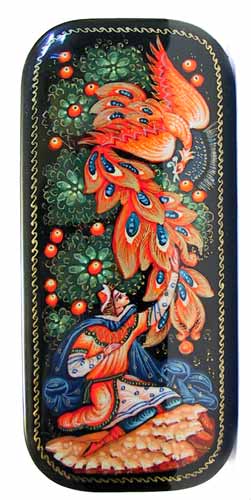
Midnight came, and to him it appeared there was light in the garden. It got brighter and brighter. All the garden was lit up. He saw the Firebird sitting in the apple tree, pecking at the golden apples. Ivan Tsarevich crawled toward the apple tree and grabbed the bird by the tail. The Firebird flapped it's wings and flew away, leaving in Ivan's hand, one feather.

In the morning Ivan Tsarevich went to his father. "Well, my dear Vanya, you didn't see the culprit either?" "Dear Father, I remember but don't remember, who destroys our garden. Here is a memento from the culprit for you to take. It is, Dear Father, the Firebird."

The Tsar took the feather, and from that time began to eat and to drink, and knew no more sorrow. It was a beautiful time to him and he pondered about the Firebird. He called his sons and said to them: "My dear children, saddle would you good steeds, go would you about the wide world, to places unknown, where you might catch the Firebird.

The children bowed to their father, saddled good horses and set out on their way. The oldest in one direction, the middle in another, and Ivan Tsarevich in the third direction. Ivan went a long time, or a short time. The day was summery. Ivan Tsarevich grew tired, got down from his horse, fettered him, and tumbled down to sleep.

A long time or a short time passed, Ivan Tsarevich woke up and saw, no horse. He went to look for him, he walked and walked and hoped to find his horse nibbling on a bush. Thought Ivan Tsarevich: where without a horse to go in such remoteness? "Well, what of it, he thought, set out, nothing else to do." And he went on foot. He walked and walked, grew tired to death. Sat on the soft grass and grew more sad. From out of nowhere ran toward him the Grey Wolf. "What, Ivan Tsarevich, sitting there grieving, your head hanging?" "How can I not grieve, Grey Wolf?" I am left alone without a good steed." "It is I, Ivan Tsarevich, who ate your horse...I'm sorry! Tell me, why are you traveling in this remote place, where are you going?" "My father sent us to go about the wide world to find the Firebird." "Pooh, pooh, you on your own good horse could not in three years go to the Firebird. I alone know where he lives.

So, and it will be, I ate your horse, and I will serve you, it's only right. Sit on me and hold on tight." Ivan Tsarevich sat on his back and the Grey Wolf leapt flying through the blue forest faster than the eye could see, past rivers and lakes. For a long time, or a short time, they flew to a high fortress. The Grey Wolf said: "Listen to me, Ivan Tsarevich, and remember: crawl over the wall, don't be afraid, it's a lucky hour, all the guards are asleep. You will see in the terem window, on the window sill stands a golden cage, and in the cage sits the Firebird. Take the bird, lay him by your breast, and look but don't touch the cage!"

Ivan Tsarevich crawled over the wall, saw the terem, on the window sill sat the golden cage, and in the cage sat the Firebird. He took the bird, laid him by his breast, and looked at the cage. His heart caught fire: "Ah, such golden decoration! How can I not take it!" And he remembered what the Grey Wolf had said to him. He only touched the cage, throughout the fortress sounds: pipes piped, the guards woke up, grabbed Ivan Tsarevich and carried him to Tsar Afron.

Tsar Afron was enraged and said: "Who are you, where are you from?" "I am the son of Tsar Ferapont. Ivan Tsarevich." "Ah, what a disgrace! A tsar's son goes out and steals." "But what about when your bird flew into our garden and destroyed it?" "But if you had come to me to ask for advice, I would have given him to you, out of respect for your father Tsar Ferapont. But now, about all the city, the most uncomplimentary glory upon you...

Well and all right, render to me a service, I ask you. In some-such principality Tsar Kusman has a horse with a golden mane. Bring him to me, then I will give you the Firebird with the cage. Ivan Tsarevich grew very excited, went to the Grey Wolf. But the wolf said to him: "I told you, don't disturb the cage! Why didn't you listen to my instructions?" "Well, I beg you, I beg you, Grey Wolf." "Well, well, I beg....Alright, sit on me. Take the rope, don't say that it is not strong." Again set off the Grey Wolf with Ivan Tsarevich.

For a long time, or a short time, they flew to the other fortress, where stood the horse with the golden mane. "Crawl, Ivan Tsarevich, over the wall, the guards are asleep, go to the stable, take the horse, and look, but don't touch the bridle." Ivan Tsarevich crawled into the fortress, all the guards were asleep.

He went to the stables, took the horse with the golden mane, and looked at the bridle. It was gold with precious stones. Ivan Tsarevich touched the bridle, and a loud noise went all through the fortress: pipes piped, the guards awoke, grabbed Ivan and carried him to Tsar Kusman. "Who are you, where are you from?" "I am Ivan Tsarevich." "Eeh, such stupidity to undertake, to steal a horse! On this even a simple peasant would agree." "Well, all right, I beg you, Ivan Tsarevich, render me a service.

Tsar Dalmat has a daughter, Elena Prekracnaya. (the beautiful) Go and get her, bring her to me, and I will give you the horse with the golden mane and his bridle." Ivan Tsarevich became more dejected than ever, he went toward the Grey Wolf. "I told you, Ivan Tsarevich: Don't touch the bridle! You didn't listen to my advice." "Well, I beg you, I beg you, Grey Wolf".

"Well well, you beg...yes, all right, sit on my back." Again sped off the grey wolf with Ivan Tsarevich. They rushed to Tsar Dalmat. He had a garden in his fortress where Elena Prekrasnaya walked with her mother and her nurse. Grey Wolf said: "This time I myself will go. You go back the way we came. I will soon catch up with you." Ivan Tsarevich went back the way they had come, and the Grey Wolf jumped over the wall and into the garden. He sat in hiding behind a bush and watched.

Elena Prekrasnaya came out with her mother and nurse. They walked and walked and her mother and nurse stopped for a bit. Grey Wolf grabbed Elena Prekrasnaya, leapt over the wall, and took flight. Ivan Tsarevich was going along the way, when suddenly the Grey Wolf caught up with him. On the wolf sat Elena Prekrasnaya. Ivan Tsarevich rejoiced, but the Grey Wolf said to him: "Sit on me quickly, for they will not be far behind." The Grey Wolf sped away with Ivan Tsarevich and Elena Prekrasnaya the way they had come, through the blue forest, faster than the eye could see, past rivers and lakes. For a long time, or for a short time, they hurried to Tsar Kusman.

The Grey Wolf asked: "Why, Ivan Tsarevich have you become even more sad?" "But, how can I not be sad, Grey Wolf? How can I be parted with such beauty? How can I exchange Elena Prekrasnaya for a horse?" The Grey Wolf answered: "I won't part you with such beauty, we will hide her somewhere, I will turn myself into Elena Prekrasnaya, and you will bring me to the Tsar." They hid Elena Prekrasnaya in a forest isba.

The Grey Wolf turned his head and became exactly like Elena Prekrasnaya. Ivan Tsarevich took him to Tsar Kusman. The Tsar rejoiced and began thanking him: "Thankyou, Ivan Tsarevich, for you have brought to me a bride. Take the horse with the golden mane and bridle." Ivan Tsarevich sat on the horse and went for Elena Prekracnaya.

He picked her up and sat her on the horse and they set out on their way. Tsar Kusman had the wedding, and feasted all day until evening. Then he needed to lie down to sleep. But when he and his young wife went up the stairs, he looked, and in place of Elena Prekrasnaya was a wolf! The tsar turned angrily toward him, but the wolf ran off. The Grey Wolf caught up with Ivan Tsarevich and asked: "Why are you so sad, Ivan Tsarevich?" "How can I not be sad? It would be a pity to part with such a bridle, and to trade the horse with the golden mane for the Firebird." "Don't grieve, I will help you." And they traveled to Tsar Afron.

The wolf said: "Hide the horse and Elena Prekrasnaya. I will turn myself into the horse with the golden mane, and you will bring me to Tsar Afron." They hid Elena Prekrasnaya and the horse with the golden mane in the forest. The Grey Wolf looked over his back and turned himself into the horse with the golden mane. Ivan Tsarevich took him to Tsar Afron.

The tsar was overjoyed and gave him the Firebird with the golden cage. Ivan Tsarevich returned on foot to the forest, sat Elena Prekrasnaya on the horse with the golden mane picked up the golden cage with the Firebird, and they traveled in the direction of his homeland. Tsar Afron commanded his servants to bring his horse to him. He wanted to sit on him, but the horse turned into the Grey Wolf.

The tsar was so surprised that he fell down right where he was standing, and the Grey Wolf took flight, quickly catching up with Ivan Tsarevich. "Now, farewell, I am not allowed to go any further." Ivan Tsarevich got down from his horse, and three times bowed down to the ground, with respect he thanked the Grey Wolf. Then he said: "You won't be parted with me forever, I again will call you into service." Ivan Tsarevich thought: "Aren't you already in my service, all of my wishes you have fufilled."

He sat on the horse with the golden mane, and again set out with Elena Prekrasnaya and the Firebird. They traveled into his region. They had only a little bread left. They traveled to a little spring and drank the water, and ate the bread, and lay down on the grass to rest. Ivan Tsarevich fell asleep. His brothers suddenly came upon him. They had traveled to other lands, seeking the firebird, and returned empty-handed. They came upon Ivan and saw all that he had acquired.

Then they said: "Let us kill our brother, all that he has gained will be ours." This decided, they killed Ivan Tsarevich. They saddled the horse with the golden mane, picked up the Firebird, sat Elena Prekrasnaya on the horse, and threatened her: "At home, don't say anything>" Ivan Tsarevich lay dead, two crows were already flying over him. From out of no where ran the Grey Wolf, and grabbed the crow and his wife. "You fly, crow, for the water of life and death.

Bring to me the water of life and the water of death, and then I will let go of your wife. The crow flew for a long time or a short time, bringing the water of life and the water of death. The Grey Wolf sprinkled the water of death on Ivan's wounds, the wounds healed.

He sprinkled him with the water of life, and Ivan got up. “Oh, how soundly I slept!” “You would have slept even sounder”, said the Grey Wolf, “if I hadn’t sprinkled you with the water of life and the water of death! Your own brothers killed you and took all that you have gained. Even now one of your brothers is to marry Elena Prekrasnaya. Sit on me quickly!”

They rushed home, where, indeed, Ivan’s brother was preparing to marry Elena Prekrasnaya. No sooner had Ivan Tsarevich entered the castle, than Elena Prekrasnaya jumped up and threw her arms around him. “This is my true bridegroom, Ivan!” she cried, “Not the evil brother sitting there!” And she told the Tsar everything the brothers had done, and how they had threatened to kill her if she told anyone what had happened.

The Tsar was very angry and threw the two oldest brothers into the dungeon. Then Ivan Tsarevich married Elena Prekrasnaya, and they lived happily ever after.

http://russian-crafts.com/russian-folk-tales/ivan-tsarevich-tale.html

Thursday, May 20, 2010

Ilya Muromets

Ilya of Murom was born near the town of Murom into a family of poor peasants. His father and mother chopped wood in the forest for a living and farmed a small plot of land and they fed Ilya who had weak legs and could not walk. For thirty years he lay on the stove without getting up and did no work.

One day, when he was thirty years of age and lying on the stove as usual and his father and mother were away at work, three old men came up to their house.
"Open the door, Ilya!" they called.

"I cannot!" Ilya called back. "My legs are weak and I dare not get up.

"You can do it if you try, Ilya. Come, get up!"

Ilya tried hard. He pulled and strained, and, swinging his legs over the side of the stove, leapt down onto the floor. Then, walking easily across the room, he opened the door and let in the old men.

"You have been very ill, Ilya, but you are well now," the old man said. "Rejoice and let your father and mother rejoice with you, for you will always be healthy and strong like a true bogatyr brave warrior! They held out a jug of water to him and said again:

"Here, drink this water and a change will come over you. There.. How strong do you feel?"

"Very strong."

"That is good. Drink some more!"

Illya lifted the jug to his lips and took a long drink.

"Well, do you feel any stronger now?"

"Yes! I feel so strong that if a ring were to be driven into the earth and I were to take hold of it, I could turn the earth upside down!"

"Good! Very good! And now listen, Ilya. You must not boast of your strength or tell anyone about it but do only that which will please your father and mother. Harm none but do good to all."

Now, this was a time when Rus' was overrun by the Tatars, and Illya of Murom decided to come to his country's defense. Kazan had been besieged, with three tsars, bohatyrs all three, leading the enemy host, and it was thither he hastened. He approached the town, and, pulling an oak tree up by the roots, began smiting the Tatars with it, and he struck down all but a few of them. Of the whole enemy host only the three tsars were still on their feet, and Ilya came up to them and said:

"Go back whence you came and tell your people never to cross our borders again. I only left you alive in order that you might do so. Rus' has Ilya of Murom defending her, and he is a great bogatyr whom none can vanquish."

The Tatar tsars went back to their own land, and Ilya of Murom rode into Kazan. The streets were empty, for the townsfolk had sought shelter in their homes and in the churches. Ilya entered a church and found it full of people who were praying and weeping.

"What are you doing here, good folk?" he asked.

"Cannot you see for yourself!" said they. "The Tatars are at our gates and there is not a man or a woman among us who is not in danger of being slain."

"Speak you of Tatars? But there are none anywhere near. Go and see for yourselves!"

They went outside, and lo! — the Tatars were indeed gone and it was as though they had never been.

After that there was much rejoicing and merrymaking, and the towns- folk thanked Ilya of Murom and begged him to stay with them.

But Ilya said:

"Nay, that I cannot do! I delivered Kazan from the Tatars, and now I must haste to other towns and free them too. Fear nothing, for no foe will come to bother you again. Live as you lived before and be at peace!"

And Ilya of Murom got on his horse and made for Kiev.

Now, all who went there took a roundabout way as the regular road was blocked by Solovei the Whistler-Robber who slew all who came near: not a bird could fly, not a beast could run, not a bogatyr could ride past him. But Ilya of Murom took the road that led straight to Kiev
and so had to pass the forest where Solovei lay in wait. On three oaks he sat and nine branches in a nest he had built for himself and from which he could see over the whole of the forest. And the moment he spied anyone he would whistle like a bird and roar like a beast, and the leaves would rain from the trees, the trees crash to the ground, and all who happened to be passing by drop dead.

Ilya of Murom came riding past the forest, and Solovei the Whistler- Robber saw him and whistled like a bird, and the leaves rained down from the trees; he roared like a beast, and Illya's horse stumbled and fell onto its knees. But Illya of Murom drove his knee into the horse's flank and cried:

"A horse of mine to fear Solovei the Whistler-Robber? Up now or I'll give you to the dogs!"

The horse stood up, and Ilya rode on. He was close now to where Solovei the Whistler-Robber was waiting, and, seeing him, Solovei leapt down to the ground and made for him. But Ilya of Murom took aim and sent an arrow straight into Solovei's right eye. The arrow pierced
Solovei's head and came out from the back of it, and Solovei fell to the ground. Illya sprang up to him, and, seizing him, held him in his grip, and Solovei knew Illya for one stronger than he and told himself that his end had come.

Ilya untied the stirrups from his saddle, and, binding the Whistler- Robber's arms and legs with strong leather thongs, tied him to it, sprang on the horse's back and made for Solovei's house.
Now, Solovei the Whistler-Robber had a daughter who was as strong as any bohatyr, and when this daughter saw Ilya of Murom come riding up, with her father hanging from his saddle, she seized an iron bar weighing all of ninety pods and hurled it at him. But Ilya of Murom
stopped the bar with his shoulder and sent it flying back and it struck Solovei's daughter and killed her on the spot. Solovei's wife came out, and, seeing that her husband's life was in danger, began to plead with Ilya, begging him to spare Solovei and promising to pay him as large a ransom in either gold or silver as he wanted. But Ilya of Murom would have none of it.

"Nay, Solovei has lived long enough!" he said. "Never would I spare one who killed and orphaned so many! And I want none of your gold. It is not riches I covet — I seek to defend the wronged and helpless!-" And turning round his horse, he headed for Kiev.

Now, it was Prince Volodimir who reigned in Kiev at the time, and when Illya of Murom arrived the Prince was holding a feast at which all his bogatyrs had gathered. Ilya told the Prince who he was, and the Prince asked him by what road he had traveled.

"By the road that runs straight to Kiev, Prince," Ilya said.

At this all the bohatyrs sprang up from their seats, and one who was more famed than any, Alyosha, Son of a Priest, said:

"He lies, Prince, it cannot be! For who can travel by the road that runs straight to Kiev, with Solovei the Whistler-Robber lying in wait there and not a bird being able to fly nor a beast to run past him!

"Do you then call yourself a true bogatyr, you who fear Solovei the Whistler-Robber?" said Ilya of Murom. "Let me show you where Solovei is!"

He led the Prince, his wife and the bogatyrs into the courtyard and pointed at the Whistler-Robber.

"There he is?" he said.

They looked, and, seeing Solovei dangling from the saddle, knew Ilya of Murom to be a true bogatyr, for who but a true bogatyr could have vanquished such a one!

Prince Volodimir said not a word to Ilya, but addressed Solovei.

"Come, Solovei, whistle like a bird and roar like a beast!" he said.

But Solovei the Whistler-Robber only sneered.

"It was not you who took me captive and it is not for you to tell me what to do!" he said.

The Prince turned to Ilya of Murom.

"Bid him do as I said?" said he.

Said Ilya of Murom:

"Come, Prince, and you, Princess, stand beside me, and I will throw my cape over you that your eardrums might not burst when Solovei whistles."

He threw his cape over them and turned to Solovei.

"Harken now, Solovei, do as I bid and whistle like a bird!" he cried.

Solovei whistled like a bird, and lo! — the leaves rained from the trees, and Prince Volodimir's bogatyrs fell to the ground and began crawling across the courtyard on all fours in their fright.

Then Solovei roared like a beast, and they stumbled and fell and were so dazed that they knew not where to go. But Prince Volodimir and his Princess were safe under Ilya of Murom's cape.

"And is this how brave you are, my gallants!" said Ilya of Murom to the Prince's bogatyrs. "Why did I not fly from Solovei as you do!"

He led Solovei the Whistler-Robber out into the field and cut off his head. And now that Solovei was dead, he stayed with the Prince and lived in his palace.

One day the bogatyrs again came to visit the Prince. They spent the time in revelry, and they quarreled with Illya and so set the Prince against him that he threw him into a dungeon. He had an earthen wall put up around it, and, thinking to starve Illya to death, sent him no food for three years. But the Prince's daughter brought him food and drink in secret from her father, and though the Prince thought him dead, Illya was alive and well.

Three years passed, and a Tatar tsar, Kalin by name, who was famed for his prowess in battle, sent a messenger to Prince Volodimir with a letter for him in which he wrote as follows:

"Kalin, Tsar of the Tatars, writes you this. Of my own lands I have not enough and wish to add your Kiev lands to them. Should you refuse to surrender Kiev I shall lead my host against you and seize it, and you and the Princess shall work in my kitchens."

Prince Volodimir read the letter and turned white with fear. He spoke to his wife, but as they could not think what to do they called their daughter and asked her counsel.

"Send for Ilya of Murom. Perhaps he is still alive," the daughter said.

"You must be out of your senses, daughter!' said the Prince. "Ilya has been kept in a dungeon without food for three years. So not only is he long dead by now but his bones have long turned to dust.

"Send for him all the same, Father!"

The Prince was vexed by this and said so, but the daughter said again:

"But, Father, what if he is still alive?"

Seeing her so insistent, the Prince argued no more.

"Very well, I'll send someone there to see."

He sent his men to the dungeon, and they dug a passage in the earthen wall and made their way into it. And lo! — there sat Ilya of Murom, alive and well, singing songs to pass the time. The men came back to the Prince.

"Ilya of Murom is alive, Prince, and as well as he ever was," said they.

"Speak you truly?" the Prince demanded.

"Aye, Prince."

"Then let us go there at once!"

And the Prince hastened to the dungeon.

He unlocked all the doors, let out Ilya of Murom and said to him in pleading tones:

"Be not wroth with me, Ilya, for letting my anger get the better of me, help me out in my trouble."

"Nay, Prince, ask not for my help. You kept me here in order to starve me to death!" said Ilya.

The Prince went away and sent the Princess, his wife, to talk to Ilya, but he would have none of her and all her pleas availed her nothing. Then the Prince's daughter offered to speak to him and went to the dungeon, and when he saw her Ilya said:

"You brought me food, maid, and did not let me die, and I will fight for you and defend Rus'. Lucky are your father and mother to have such a daughter!"

Out he stepped from the dungeon and went forth to war against Tsar Kalin. He routed Tsar Kalin's host, but Tsar Kalin was a strong man and a true bohatyr and he said that now that his men had fallen in battle he would himself fight Ilya of Murom. For three long days they fought, and Tsar Kalin got the better of Ilya He threw him to the ground and held him in an iron grip."

But Tsar Kalin, who had three beautiful daughters, did not mean to kill Ilya of Murom but only to frighten him. So he pulled out his dagger and cried: "Beware, for I will cut you to ribbons, Ilya of Murom!- And in the next breath: "Nay, live, bogatyr! Take one of my daughters to wife and join forces with me! Leave your princes! Why should you fight for them when they do nothing for you?"

Now, Ilya of Murom knew, for so the old men who had cured him of his long illness had told him, that he drew his strength from his native soil and that the longer he lay on the bare earth the stronger
he would become. So when Tsar Kalin threw him down and held him pinned to the ground, he was glad, for he felt himself growing stronger. He lay there and waited, and Tsar Kalin, seeing him so calm, was enraged and said:

"Refuse to do as I say, and you will die!"

But Ilya made no reply, and it was only when he felt himself to have become strong again, stronger than ever he was, that he caught Tsar Kalin with his legs and hurled him high. Up into the air a full ten meters flew Tsar Kalin and then he fell to the ground and there was little life left in him. And Ilya of Murom seized him by the legs and began swinging him round and round, using his body to smite those men of his who were still alive. And in this way he slew them all.

After that he came back to Kiev, married Prince Volodimir's daughter and lived out his life in peace.

http://russian-crafts.com/russian-folk-tales/ilya-murome-tale.html